AdBlue in the Diesel Fuel Tank: What to Do and What Not to Do
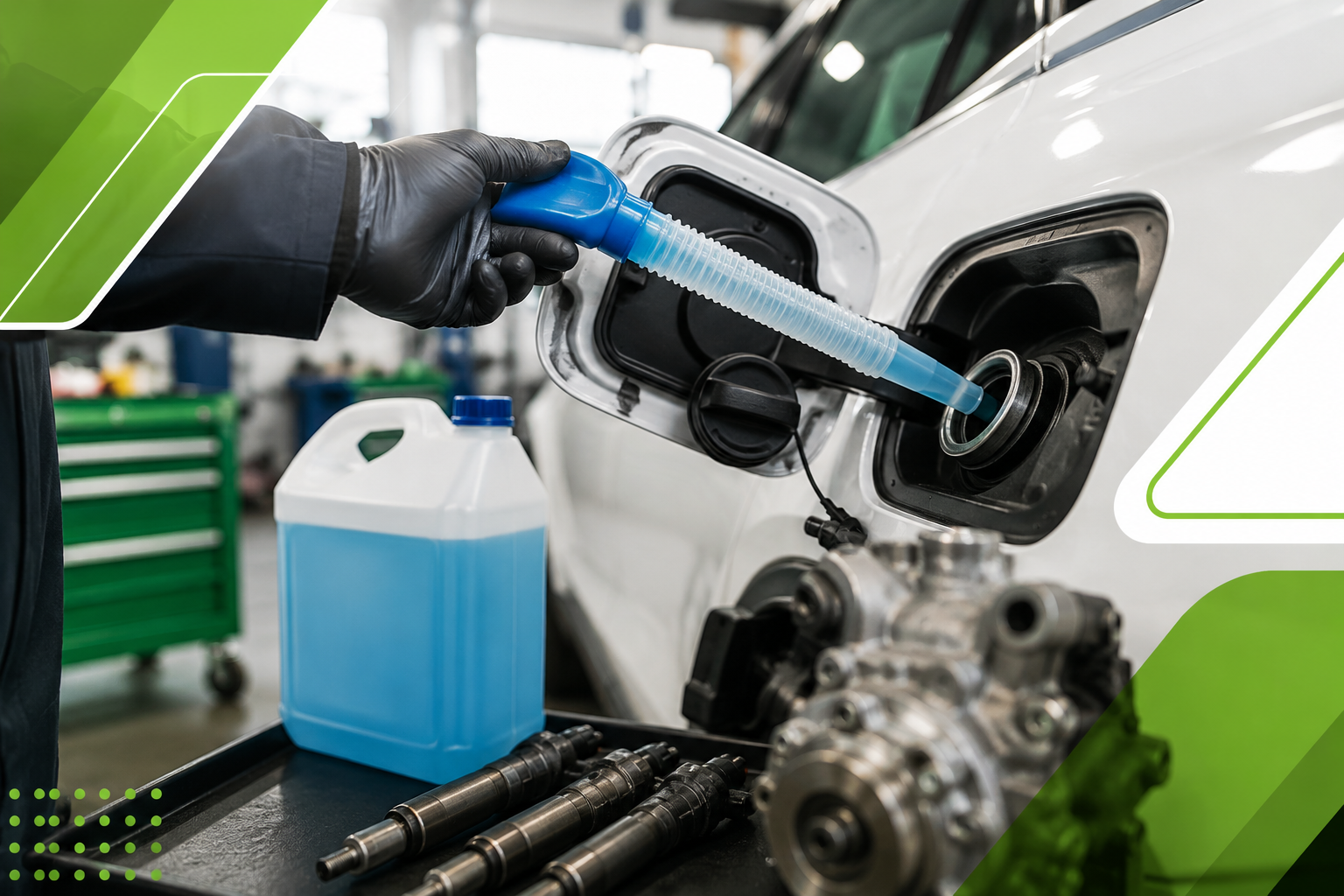
Anyone can make a mistake at the pump. One of the most dangerous situations for a diesel car is when AdBlue goes straight into the fuel tank.
At first glance it may seem enough to just top up with diesel and keep driving. In reality, this situation calls for caution. AdBlue is not a fuel additive and is not meant to get into the diesel fuel supply system.
Starting the engine after this kind of mistake is especially risky. The longer the car runs with the wrong fluid in the fuel system, the more extensive the damage can be.
What is AdBlue and why is it dangerous for the fuel system?
AdBlue is a special solution used in the exhaust aftertreatment systems of diesel vehicles with SCR technology. It is fed not into the fuel system but into the exhaust system, where it helps reduce nitrogen oxide emissions.
In both composition and purpose, AdBlue is fundamentally different from diesel fuel.
Diesel fuel injection equipment, especially Common Rail systems, is designed to run specifically on diesel fuel, which at the same time provides the conditions the precision parts of the fuel pump and injectors need to work.
AdBlue must not get into this circuit.
What happens if AdBlue gets into the tank?
Once AdBlue is in the fuel tank, it mixes with the diesel. If the engine has not been started yet, the situation is usually easier to fix, because the fluid has not had time to pass through the whole fuel system.
But if the car has already been started after the misfuel, the mixture begins flowing to the fuel pump, the fuel rail and the injectors.
In that case, the risk of damage to fuel system components rises considerably.
That is why the most important rule is not to start the engine once you realize AdBlue has gone into the tank.
What to do if AdBlue gets into the fuel tank
First of all, don't panic. If you spot the mistake while still at the filling station, do not start the engine and do not try to drive to a workshop under your own power.
Even if the car shows no symptoms yet, that does not mean the fuel system is safe.
Next, arrange for the car to be taken to a service center and have the contaminated fuel drained from the tank. After that, technicians should assess whether the mixture has made its way further into the fuel system.
The amount of work required depends primarily on whether the engine was running after the misfuel.
If the engine has not been started
This is the best-case scenario.
If AdBlue went into the tank but the engine was not started, the main goal is to keep the mixture from reaching the high-pressure components.
In this situation, the usual steps are to drain the contaminated fuel, clean the tank and assess the condition of the fuel system according to the design of the specific vehicle.
Once the necessary work is done, the system is filled with clean diesel.
The sooner the car gets to a service center after the misfuel, the lower the chance that the contaminated fuel travels further through the system.
If the car has already been started
Here the situation is more complicated.
If the engine has already run, the AdBlue mixture may have passed through the fuel line and reached the high-pressure fuel pump (HPFP) and the injectors.
In that case, simply draining the tank is not enough. You need to determine how far the contaminated fluid has traveled through the fuel system.
Technicians can check the fuel pump, the injectors and other system components. If necessary, the fuel system is cleaned and the components that came into contact with the contaminated fuel are diagnosed.
What happens if you keep driving?
This is the worst way the situation can play out.
At first, the driver may not notice any serious change in how the car runs. But that does not mean AdBlue is not affecting the fuel system.
As the wrong mixture works its way through the system, the following may appear:
- hard starting;
- unstable running;
- loss of power;
- increased smoke;
- fuel system fault codes;
- a drop in fuel rail pressure;
- HPFP failure;
- injector damage.
As a result, a fueling mistake that could have been fixed by cleaning the system can potentially turn into a much more expensive repair.
Can you just add more diesel?
No, that is not the right way to solve the problem.
You will sometimes hear the advice that if AdBlue gets into the tank, you should simply fill it up with as much diesel as possible to dilute it.
But this cannot guarantee that the fuel system will run safely. Dilution does not remove AdBlue from the tank and does not stop it from reaching the fuel injection equipment.
So rather than experimenting, the better course is to take the car to a service center.
Do the injectors need replacing after AdBlue contamination?
Not necessarily.
This is an important point. The mere fact that AdBlue got into the tank does not mean the injectors have to be replaced right away.
First, you need to establish whether the contaminated mixture reached the injectors and what condition they are in. If the engine was not started, the risk of damage to the high-pressure components is much lower.
If the car was running, it makes sense to check the injectors on a specialized test bench. Based on the results, you can determine whether they need repair or replacement, or whether cleaning the system is enough.
What about the HPFP?
The high-pressure fuel pump also needs particular attention, because it is one of the most expensive and most precise components of a diesel fuel system.
If the contaminated mixture has already reached the pump, its condition has to be assessed. This is especially relevant for Common Rail systems, where the precision of the closely machined parts is critical.
Don't wait for serious symptoms before checking the HPFP. The earlier the problem is identified, the better the chance of avoiding a major repair.
What you should never do
If AdBlue has gotten into the fuel tank:
- Don't start the engine. If you haven't started the car yet, don't do it even just to "see if everything is fine."
- Don't try to drive to a service center under your own power. Call a tow truck or use another safe way to transport the car.
- Don't dilute the AdBlue with a large amount of diesel. It does not fix the problem.
- Don't keep driving if the engine has already been started. It is better to stop and have it diagnosed.
- Don't replace expensive components without testing them. First you need to determine exactly what has been damaged.
What determines the scope of the repair?
There is no universal list of work that applies to every car. A lot depends on how much AdBlue went into the tank, the design of the fuel system and whether the engine was started.
Broadly speaking, there are two scenarios.
- AdBlue went into the tank, but the engine was not started. In most cases the situation can be resolved much more simply, because the contaminated fuel has not yet passed through the whole system.
- The engine has already run. In this case a more thorough check of the fuel system is needed and, if required, HPFP diagnostics and injector testing.
That is why, in this situation, it is important to tell the technician exactly what happened, roughly how much AdBlue went in and whether the engine was started afterward.
Conclusion
AdBlue in the fuel tank is not something to ignore or try to sort out yourself. The best thing you can do after a misfuel is not start the engine and contact specialists.
If the engine has already run, a diagnosis is needed to determine whether the contaminated mixture reached the HPFP and the injectors. Expensive components do not always need replacing; in each case the decision should be based on the test results.
The sooner you seek help, the better the chance of getting away with a fuel system cleaning and avoiding an expensive repair.