How Do You Know When Injector Back-Leakage Has Become a Problem?
Excessive back-leakage can affect the entire fuel system, especially when starting the engine. If internal leaks in the injectors send a large share of the fuel back to the tank, the high-pressure fuel pump (HPFP) may struggle to build the required rail pressure.
In that case, the following typical signs may appear:
- The engine takes a long time to start. While the starter is cranking, the fuel system does not always manage to build enough pressure to start. The problem can be especially noticeable on a hot start.
- The engine runs unevenly. If the injectors have different back-leakage readings or other faults, this may be accompanied by rough running, vibration and unstable rpm.
- Power drops. When fuel rail pressure is too low, the system may limit fuel delivery, so the engine loses pulling power and responds worse to the accelerator pedal.
- Fuel pressure fault codes appear. The ECU may log a mismatch between the specified and actual rail pressure. However, these codes can be caused not only by the injectors but also by the HPFP, the pressure regulator, the fuel filter or other parts of the system.
It is important to understand that these symptoms are not conclusive proof of excessive back-leakage. They only indicate that the fuel system needs checking and the source of the problem needs to be found.
Does equal back-leakage mean all the injectors are good?
Not necessarily. If all the injectors return roughly the same amount of fuel during the test, that still does not guarantee they are fully serviceable.
A back-leakage test primarily assesses internal fuel leakage. It does not directly show atomization quality, spray pattern, metering accuracy or every operating mode of the injector.
For example, an injector can have normal back-leakage but still atomize fuel poorly or deviate from its specified delivery. Faults like these require other test methods.
That is why a comprehensive diagnosis takes into account not only back-leakage but also engine operating data, fuel rail pressure, delivery corrections and the results of other tests. If necessary, the injectors are tested on a specialized diagnostic test bench.
Can back-leakage be checked without removing the injectors?
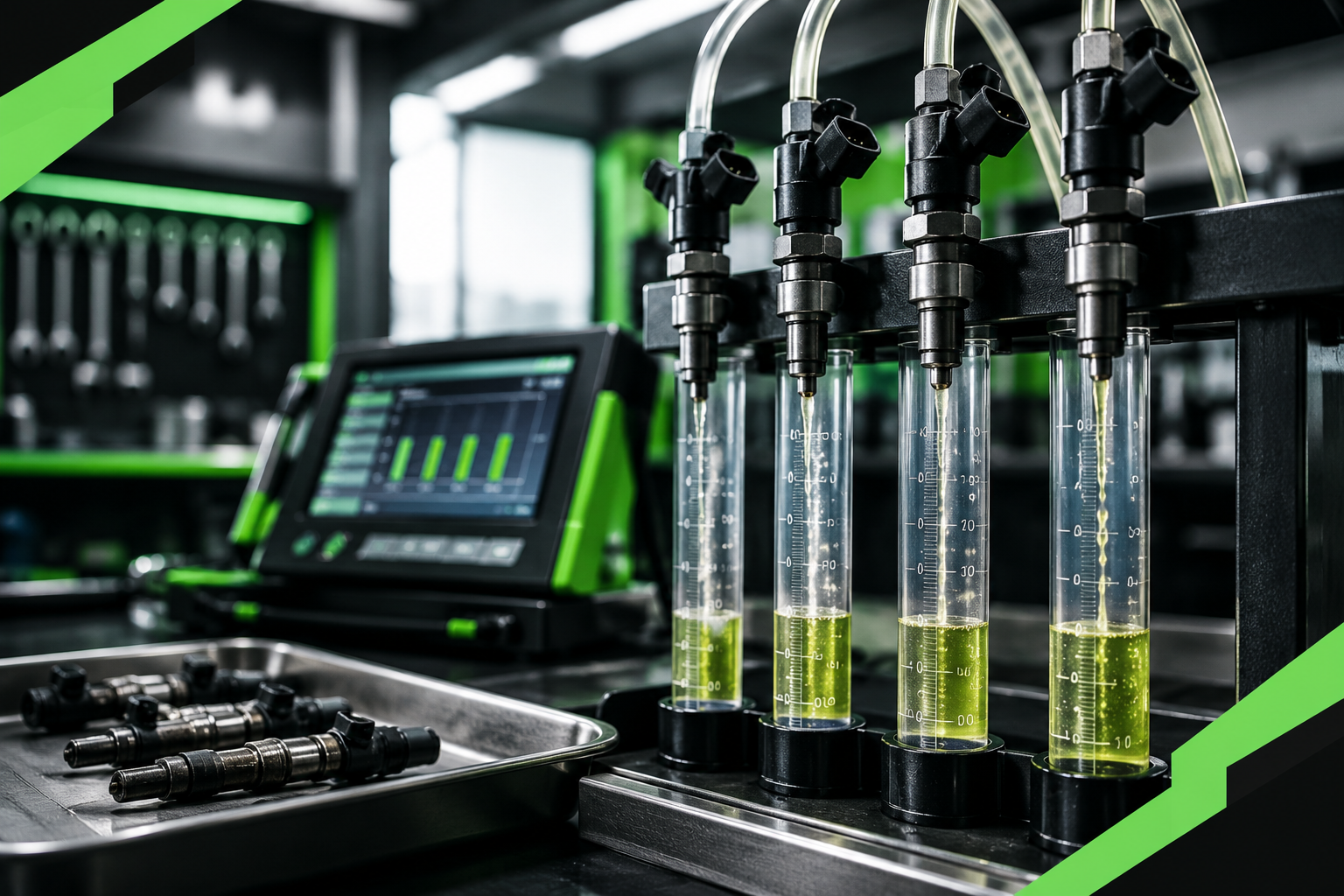
Yes. On many Common Rail systems, a back-leakage test can be done without removing the injectors. This uses special adapters, hoses and measuring vessels connected to the return ports.
This gives a preliminary assessment of the injectors without taking them out of the engine. The check is especially useful if the car is hard to start, runs unevenly or shows signs of low fuel rail pressure.
However, the test must follow the procedure specified for the particular fuel system. Fuel temperature, engine operating mode, measurement duration and correct connection of the equipment all matter. Different injector types may have different test requirements.
If the results point to a deviation, the next step may be removal and bench testing. This gives a more detailed picture of the injector's condition and shows whether it needs a repair or replacement of individual components.
Why is it important to diagnose injectors correctly?
Excessive back-leakage can cause fuel system pressure problems, but injectors should not be replaced based on a single reading. Similar symptoms can be caused by a faulty HPFP, pressure regulator or fuel filter, leaking lines or other faults.
At the SinDiesel service center, diesel injector diagnosis starts with assessing the symptoms and checking the fuel system parameters. If needed, a back-leakage test and bench testing of the injectors are carried out. This helps identify the nature of the fault and choose the next course of action, repair or replacement, on solid grounds.
Do not put off a check if the engine has started taking a long time to start, has lost power or runs unevenly. Timely diagnosis helps catch the problem early and avoid unnecessary spending on replacing good parts.
Conclusion
Injector back-leakage is an important diagnostic indicator that helps detect excessive internal fuel leakage in a Common Rail system. If one or more injectors return more fuel than the manufacturer's specification allows, this can prevent the system from building the required pressure and make the engine run poorly.
On its own, however, the test result does not give a full picture of the injector's condition. To pinpoint the cause of a fault, it has to be assessed together with other diagnostic indicators. Only a comprehensive check shows whether the injector needs repair or whether the problem lies with another part of the fuel system.