Over-Fueling Injector: How to Spot It and Why It Is Dangerous
"The injector is over-fueling" often gets said as if it were a clear-cut diagnosis. In reality, this phrase can cover a range of different injector faults, and their consequences for the engine differ as well.
In a diesel fuel system, the injector has to deliver a precisely defined amount of fuel at exactly the right moment. If it loses its seal, atomizes fuel poorly or has excessive back-leakage, the way the engine runs changes. That is why it is important not just to note that the injector is "over-fueling," but to determine exactly what is happening inside the injector and why.
What does it mean when an injector is "over-fueling"?
In everyday use, the term usually describes a situation where the injector delivers more fuel into the cylinder than the engine management system calls for.
This can happen because of a worn or damaged nozzle, a leaking needle, problems with the control valve or other internal faults. As a result, the injector does not deliver the correct injection timing and quantity.
However, there is another situation that is also often called "over-fueling." This is excessive injector back-leakage. In this case the problem is not that excess fuel goes straight into the cylinder, but that too much fuel returns through the return line.
This is especially important for Common Rail. Excessive back-leakage can leave the system unable to build the required pressure in the fuel rail.
So the statement "the injector is over-fueling" is not enough on its own to identify the fault.
What symptoms can point to an over-fueling injector?
A faulty injector can show itself in different ways depending on the nature of the defect and the design of the specific fuel system.
One of the most common symptoms is unstable engine running. At idle there may be vibration, uneven rpm or a feeling that the engine is not firing on all cylinders.
The car may be harder to start, especially after sitting for a long time or when the engine is hot. Under acceleration there may be hesitation, loss of power and uneven revving.
Another telltale sign is a change in exhaust color. If too much fuel gets into the cylinder or it is atomized incorrectly, some of it may not burn properly. This may be accompanied by increased smoke.
Diesel consumption may also rise, the exhaust may smell of unburned fuel, or fuel system fault codes may appear.
At the same time, none of these symptoms proves that the injector is to blame. Similar signs can be caused by a faulty high-pressure fuel pump (HPFP), low compression, pressure control problems, air leaks into the fuel system and other faults.
Why is an injector that delivers too much fuel dangerous?
If an injector really is delivering excess fuel into the cylinder, it affects more than just fuel consumption.
Poor atomization and excess fuel disrupt combustion. This can increase smoke and the load on the exhaust aftertreatment system. For cars with a DPF this is particularly undesirable, since poor combustion can contribute to increased soot formation.
In some cases fuel can get onto the cylinder walls. The danger is that the fuel film can wash the oil off the walls, worsening the operating conditions for the piston and cylinder assembly.
If the problem is left unattended for a long time, it can lead to increased engine wear and other faults.
A separate risk is fuel getting into the engine oil. When this happens, the oil level can rise and the oil's properties deteriorate. Running an engine on fuel-diluted oil can have serious consequences.
That is why, if you suspect an injector is over-fueling, you should not just clear the fault code from the ECU memory and leave it at that.
What if the injector has high back-leakage?
This is a different situation, even though people also often call it "over-fueling."
In a Common Rail system, some fuel returns through the return line. A certain amount of return flow is normal, but if one injector leaks back significantly more than the others, this may indicate internal wear or a fault.
In that case the HPFP is forced to constantly make up for the losses. If it cannot make up enough, fuel rail pressure drops.
As a result, the car may take a long time to start, lose power, run unevenly or not start at all.
How to check whether an injector really is over-fueling
It is impossible to pinpoint the fault from outward symptoms alone. Even the injector correction values you can see with diagnostic equipment do not give a full picture of its technical condition.
For an initial on-vehicle check, a back-leakage test can be used. It lets you compare how much fuel each injector returns and spot an obvious deviation in one of them.
But this test does not show all of the injector's operating parameters.
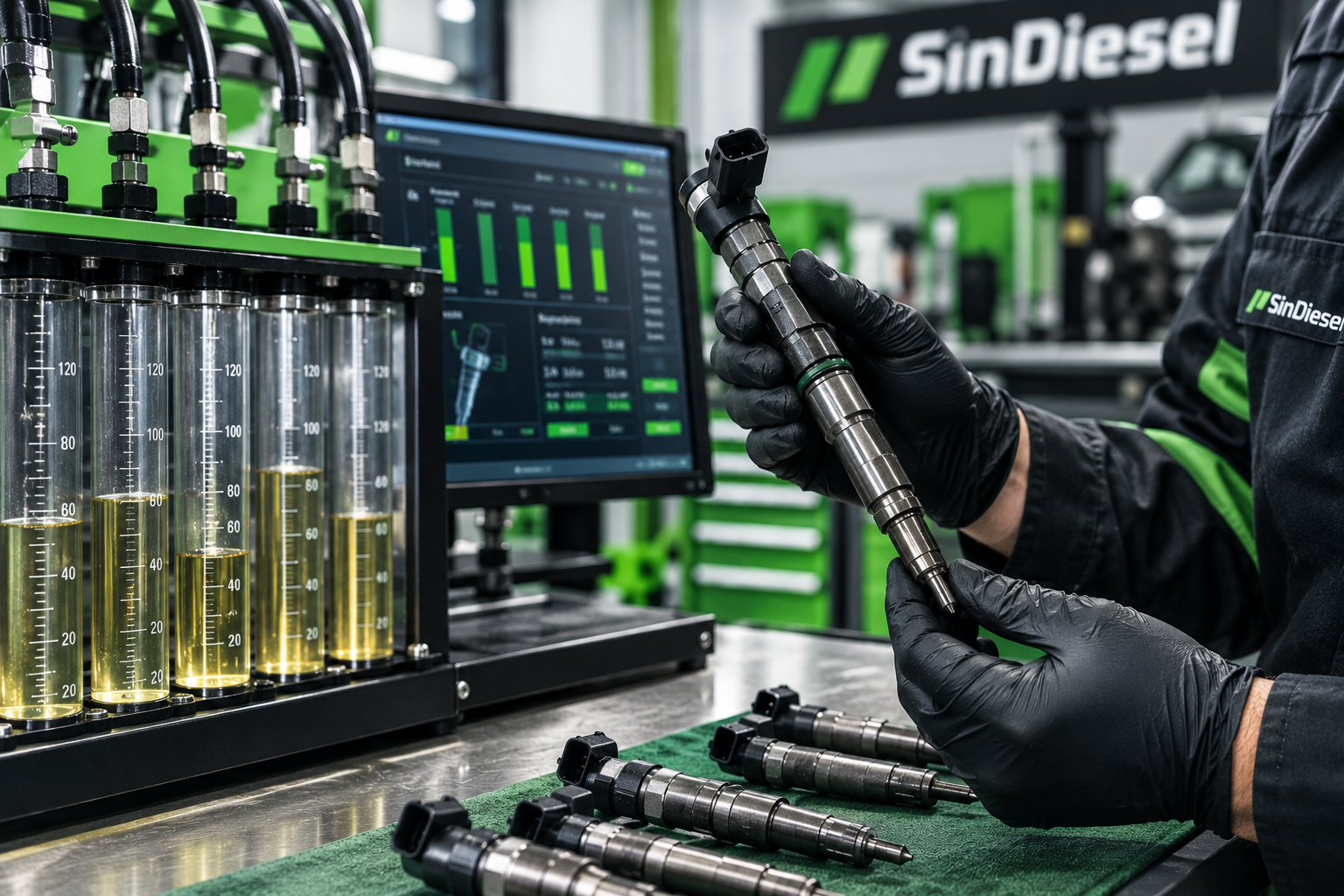
For an accurate assessment, the injector needs to be checked on a test bench. Bench testing makes it possible to evaluate its performance in different modes, delivery quantity, back-leakage, sealing and other parameters depending on the injector type.
It is this kind of test that shows whether the injector really is over-delivering or whether the problem lies elsewhere.
Can an over-fueling injector be repaired?
Not every faulty injector needs to be replaced.
After bench testing, the technician determines which components are out of spec and whether a repair makes sense. In some cases it is enough to replace individual worn components, after which the injector has to be tested and adjusted again.
If the internal parts are critically worn or damaged, a repair may not be technically or economically viable. In that case, replacing the injector is considered.
So the "repair or replace" decision should be made after diagnostics, not just on the basis of the car's symptoms.
Do all the injectors need replacing if one is over-fueling?
No, a fault in one injector does not automatically mean the whole set has to be replaced.
First, all the injectors are checked to establish their actual condition. If one shows a significant deviation and the others are working within acceptable limits, there is no reason to replace good parts just so they are all the same age.
The situation may be different after serious fuel system contamination or metal shavings from the HPFP. In that case the condition of all system components has to be assessed, since the contamination may have reached several injectors.
Can you keep driving with an over-fueling injector?
It is not advisable.
If the fault has been confirmed, continuing to drive the car can make things worse not only for the injector but for other components as well.
It is especially risky to keep driving if heavy smoke, unstable engine running, a sharp rise in fuel consumption, a rising engine oil level or hard starting have appeared at the same time.
In that situation, it is better to determine the cause of the fault first and only then decide on further use of the car and on repairs.
Conclusion
"The injector is over-fueling" is not a complete diagnosis. The phrase can mean either excess fuel delivery into the cylinder or excessive back-leakage.
In the first case, combustion is disrupted, and smoke, fuel consumption and the load on the engine and exhaust aftertreatment system may increase. In the second, fuel rail pressure may drop, causing hard starting or loss of power.
So if you suspect an injector fault, it is important not to stop at computer diagnostics or a single test. The exact condition of an injector is determined by a comprehensive check and, if necessary, bench testing. After that you can decide whether a repair, replacement of a single injector or additional checks of other fuel system components are needed.