White or Black Exhaust Smoke: Which Is Worse for a Diesel Engine?
Why exhaust color matters
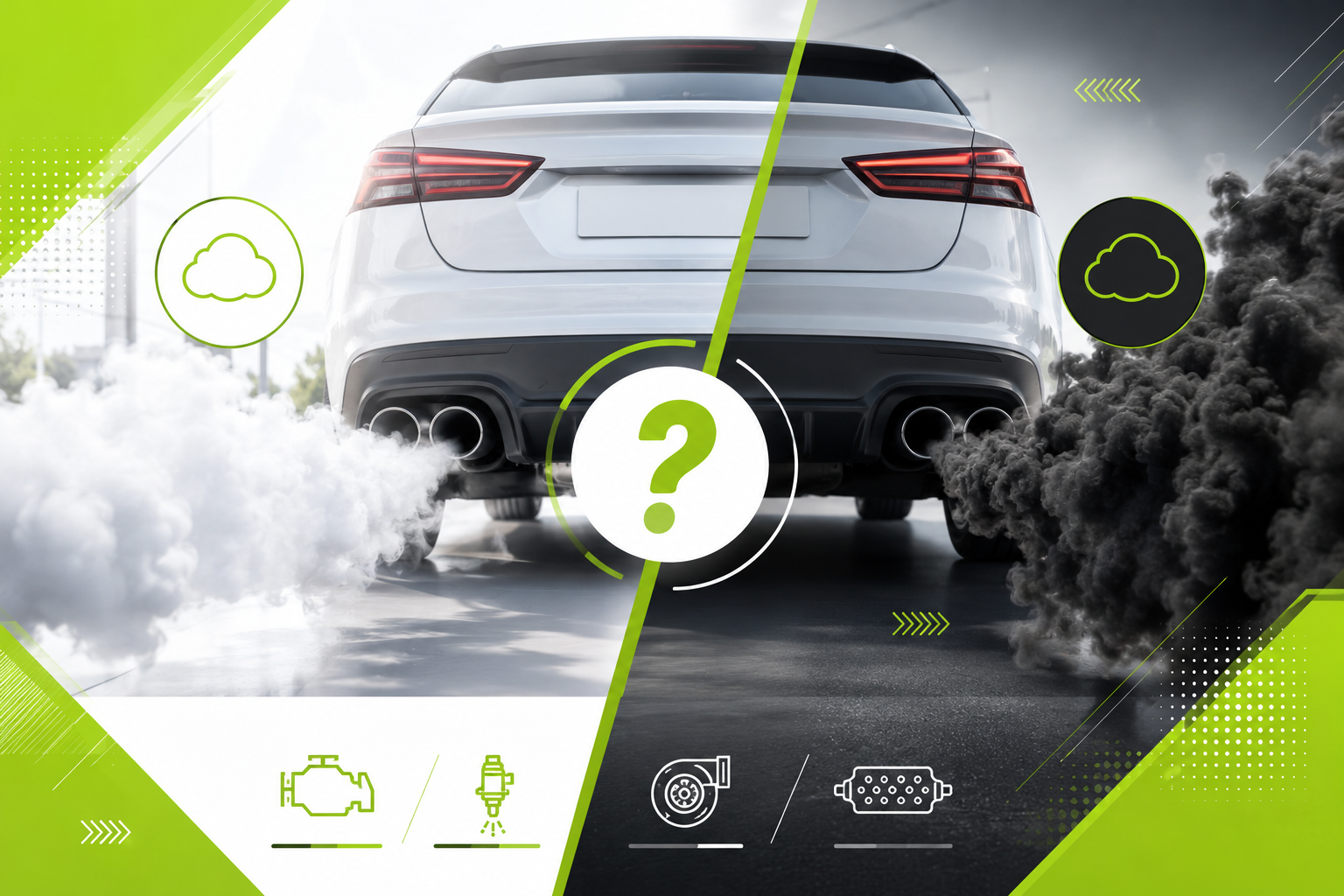
If your diesel has started smoking, don't ignore it. The color of the exhaust can tell you a lot about the condition of the engine and fuel system. White or black smoke is what owners notice most often, and the first question is usually: which one is more dangerous?
In reality, there is no simple answer. Both can point to serious faults, but they have different causes. To avoid an expensive repair, it is not enough to notice the color of the smoke; you also need to get the vehicle diagnosed in time.
What black smoke means
Black smoke means the fuel is not burning completely. Most often this is caused by too much diesel or too little air in the combustion chamber.
The most common causes include:
- faulty or dirty injectors;
- a high-pressure fuel pump (HPFP) that is not working correctly;
- a clogged air filter;
- a faulty turbocharger;
- EGR system problems;
- incorrect sensor readings.
If black smoke appears only under hard acceleration, it is not always a critical problem. But if the vehicle smokes all the time, that is a sign of a fault that needs checking.
Why black smoke is dangerous
When fuel does not burn completely, the engine runs less efficiently. Diesel consumption rises and more carbon forms, which settles on the injectors, valves, turbocharger and exhaust system components.
If the problem is ignored for a long time, it can lead to premature wear of the fuel system and an expensive repair.
What white smoke means
White smoke can have different origins.
If it appears only when the engine is cold and quickly disappears once it warms up, it is often just water condensation and nothing to worry about.
It is a different story when thick white smoke persists even after the engine has warmed up. In that case, possible causes include:
- faulty injectors;
- incorrect injection timing;
- low compression;
- coolant getting into the cylinders;
- a failed cylinder head gasket.
That is why persistent white smoke often calls for a full engine diagnosis.
When white smoke is more dangerous
If thick white smoke is accompanied by coolant loss, engine overheating or a milky emulsion under the oil filler cap, it may indicate serious mechanical damage to the engine.
In this situation, it is better to stop driving the vehicle until the exact cause has been found.
So which is worse, white or black smoke?
The color of the exhaust alone does not determine how serious the fault is.
Black smoke is more often linked to fuel system problems, air supply or incomplete combustion.
White smoke can point either to faulty injectors or to far more serious problems with the mechanical side of the engine.
So the danger lies not in the color of the smoke but in what is causing it.
When to get a diagnosis
Don't put off having the vehicle checked if:
- the smoke appeared suddenly;
- there is noticeably more of it;
- engine power has dropped at the same time;
- fuel consumption has gone up;
- the engine has started running unevenly;
- you hear unusual noises or see warnings on the instrument panel.
The sooner the cause is found, the lower the chance of an expensive repair.
Conclusion
White and black exhaust smoke are signals you should not ignore. Black smoke most often points to fuel system or air supply problems, while thick white smoke can indicate either faulty injectors or serious engine damage.
The only way to pin down the cause is a professional diagnosis. It helps you fix the fault in time and avoid a far more expensive repair.