Can Metal Debris from the HPFP Damage the Injectors?
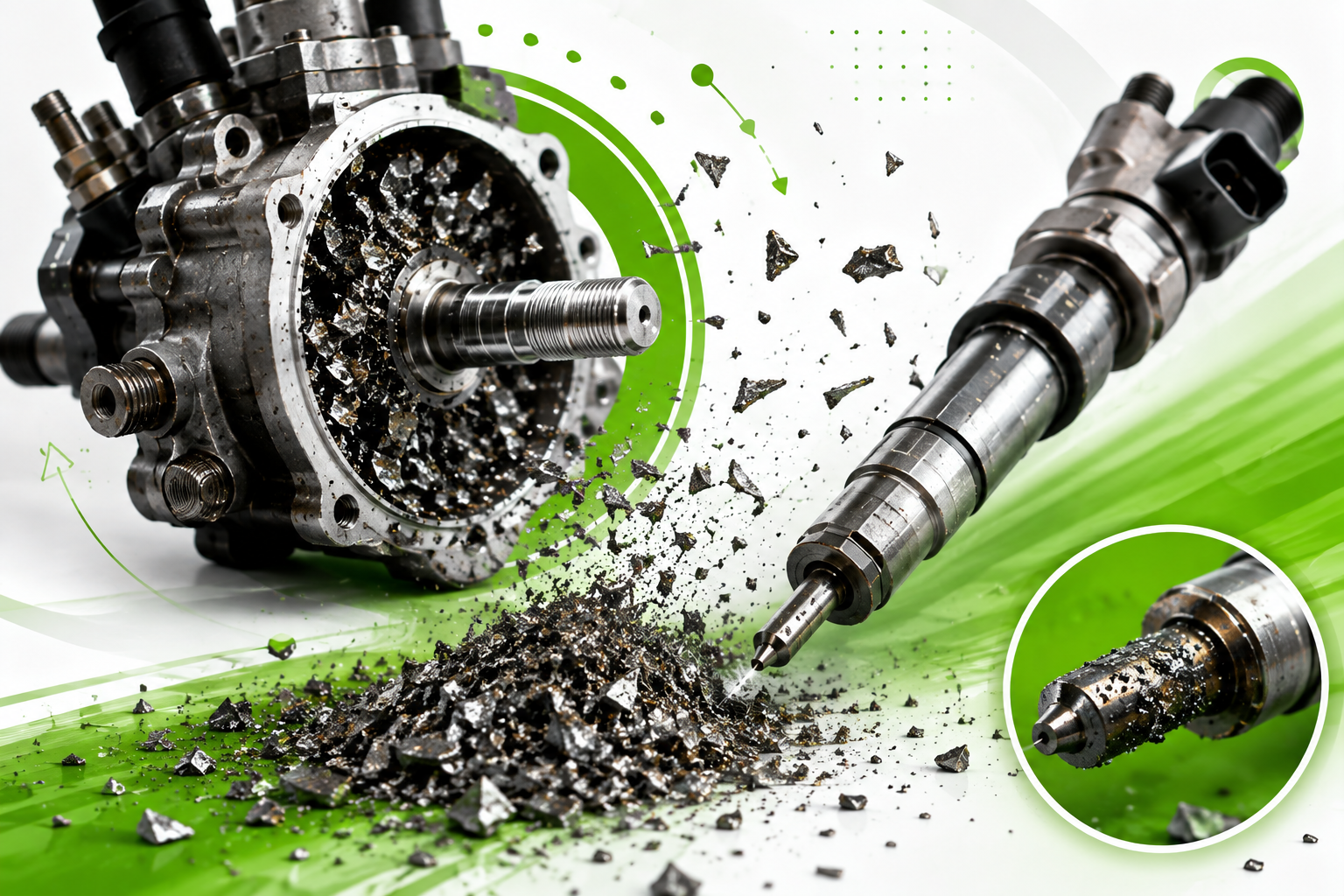
The high-pressure fuel pump (HPFP) is one of the key components of a Common Rail system. While it runs, every component in the fuel system should be receiving clean fuel free of solid contaminants. However, when the HPFP's internal parts are badly worn, metal debris can form inside the pump.
At that point it is no longer just a pump fault. Metal particles start circulating through the system with the fuel and can reach the fuel rail and the injectors. Because injectors are built to extremely fine tolerances, even a small amount of abrasive particles can wear them and disrupt normal operation.
That is why, once metal debris has been found in the HPFP, repairing or replacing the pump alone is not enough.
How metal debris reaches the injectors
Fuel leaves the HPFP under high pressure and goes to the fuel rail, from where it is distributed to the injectors. If the pump is already breaking up and producing metal particles, they travel around this circuit with the fuel.
As a result, metal debris can end up in practically every part of the fuel system. Some of the contamination is caught by the fuel filter, but if there are a lot of metal particles or the filter can no longer do its job, they can reach the high-pressure components.
This is especially dangerous for Common Rail injectors, where the working clearances between precision parts are very small.
What happens to the injector
Metal debris can damage the injector's internal precision surfaces. This changes its operating parameters, impairs sealing or disrupts the injection process.
The driver may notice that after the HPFP problems the vehicle starts running unevenly, becomes harder to start or loses power. Higher fuel consumption, a smoky exhaust and rough engine running may also appear.
Yet from the outside the injector may look perfectly fine. That is why its condition cannot be judged by eye.
Do all the injectors have to be replaced?
Not necessarily.
Metal debris in the fuel system does not automatically mean every injector needs replacing. First they need to be tested on a dedicated test bench.
Bench testing shows how closely the injectors' actual parameters match the required values. Based on the results, a decision is made: the injector is serviceable, needs repair, or is not worth reconditioning.
This approach avoids replacing good parts unnecessarily and pins down exactly how much repair work is needed.
Why simply fitting another HPFP is not enough
This is one of the most important things to keep in mind after a pump failure.
If you just replace the HPFP but leave metal particles in the fuel system, they can get into the new pump and the repaired injectors. In that case the risk of the fault recurring remains very high.
So once metal debris has been found, the extent of the contamination needs to be established and the fuel system cleaned thoroughly. The scope of work depends on the system design and how badly it is contaminated.
Usually the fuel tank, lines, rail, fuel filter and injectors are also checked.
How to tell whether the injectors are already damaged
Only bench testing gives a definitive answer, but certain signs may point to injector problems.
After an HPFP failure, pay particular attention to:
- hard starting;
- rough idle;
- loss of power;
- higher fuel consumption;
- black or white smoke;
- increased vibration;
- fuel system fault codes.
Keep in mind that these symptoms can have causes other than the injectors. So they cannot be the only way to identify the fault.
What to do if metal debris is found in the HPFP
First of all, stop driving the vehicle and don't try to solve the problem by replacing a single component.
The source of the metal particles needs to be identified, the condition of the HPFP assessed and the injectors tested. After that, the technicians can determine how much repair and fuel system cleaning is needed.
The earlier the problem is caught, the less likely it is that the metal debris will damage other expensive components.
Conclusion
Yes, metal debris from the HPFP can damage the injectors. The situation becomes especially dangerous when the vehicle is kept in use after the pump has started to break up.
If metal debris has been found in the HPFP, you need to check not only the pump itself but also the other fuel system components. The injectors should be tested on a dedicated test bench; that is the only reliable way to assess their condition and decide on the next repair steps.
Timely diagnostics help you avoid a repeat failure and the needless cost of replacing serviceable components.