Do You Need to Replace All the Injectors at Once? Diagnostics, Repair and Replacement
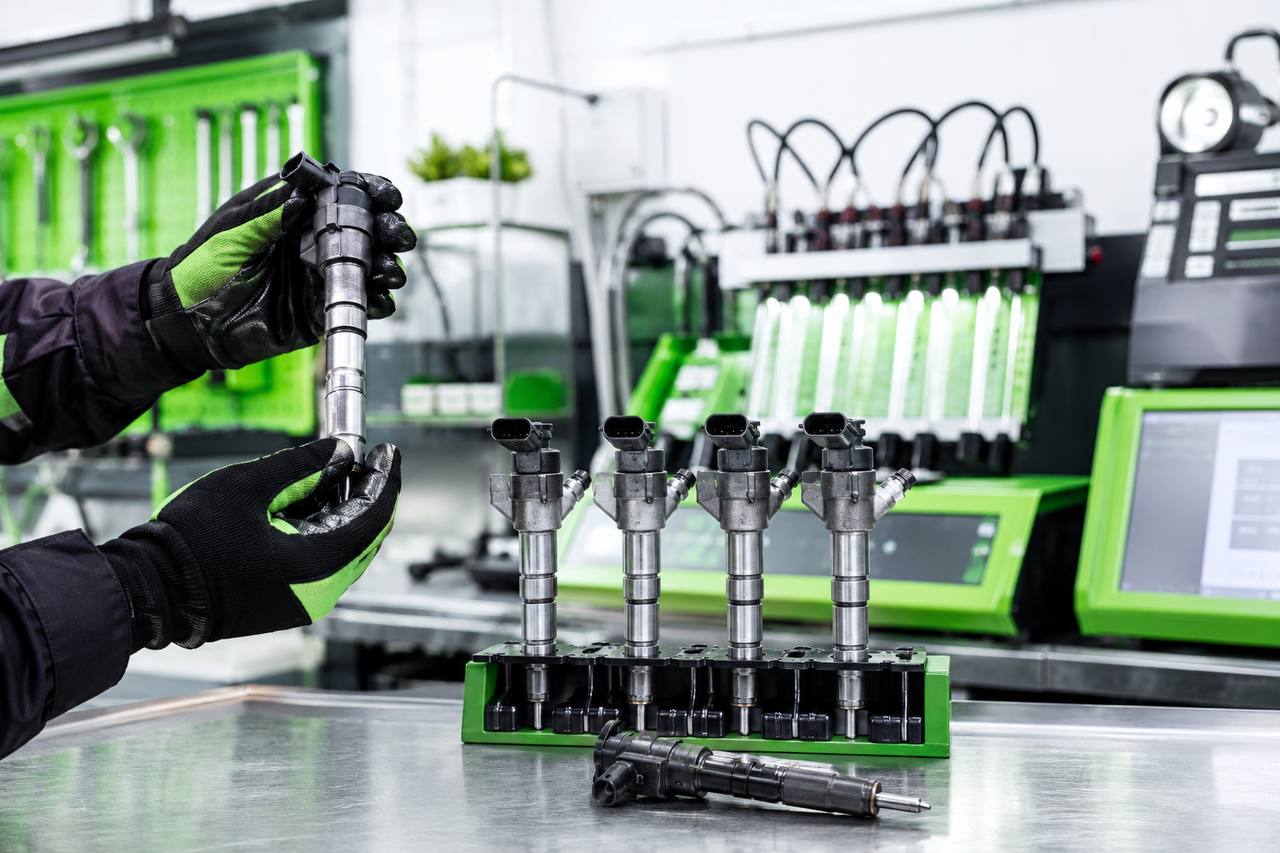
When one injector starts misbehaving, owners are often told: "replace the whole set at once". At first glance this seems logical: the injectors work in the same engine and have roughly the same mileage. In practice, though, replacing them all is far from always necessary.
In many cases a good injector can be left alone, a faulty one repaired, and only the one that can no longer be reconditioned replaced if need be.
So the right approach to diesel injector repair starts not with replacement but with diagnostics.
Why you shouldn't replace the whole set straight away
The injectors in one engine do work under the same conditions, but that does not mean they wear in exactly the same way.
Their condition is affected by fuel quality, operating conditions, the state of the fuel filter, mileage and the particular behavior of each cylinder. So it is entirely possible for one injector to be badly worn, a second to be running out of spec, and the other two to still be in good order.
Replacing all four or six injectors without testing them first can cost you far more than necessary.
That is why the actual condition of each injector has to be established first.
How do you know the injectors need testing?
Owners usually notice changes in how the vehicle runs before a serious fault develops.
Reasons to get a diagnosis include hard starting, rough idle, loss of power, higher fuel consumption or smoke from the exhaust.
Sometimes the engine starts running harsher or makes a distinctive unusual noise. On modern diesels, fuel system fault codes may also appear.
However, none of these symptoms on its own proves that an injector is at fault. Similar signs can be caused, for example, by problems with the high-pressure fuel pump (HPFP), fuel filter, sensors, compression or air supply.
What does injector diagnostics show?
To assess an injector's condition accurately, it is tested on a dedicated test bench.
The test shows how the injector performs in different operating modes, whether its delivery meets the required parameters, how well it seals and whether it forms the correct spray pattern.
This kind of testing reveals the injector's real condition instead of drawing conclusions from the vehicle's behavior alone.
Testing the whole set is especially important if one injector has already turned out to be faulty. It gives a picture of the overall state of the fuel system and makes sure no injectors that are already out of spec are missed.
Does a faulty injector always have to be replaced?
No.
In many cases the injector can be repaired. Diagnostics show which components are worn and whether the injector can technically be reconditioned.
The repair may involve replacing worn precision parts, nozzles and other components, depending on the injector design and the nature of the fault.
After reassembly, the repaired injector is always tested and calibrated on the bench. In other words, the result is judged not by how the injector looks but by its actual operating parameters.
When is it better to replace the injector?
Repair does not make sense in every case.
If the internal components are critically worn, the body is damaged, or reconditioning will not deliver stable performance, replacing the injector is the more sensible option.
The cost of reconditioning also plays an important role. Sometimes diagnostics show that repairing a particular injector would not be cost-effective compared with fitting a new or a quality remanufactured unit.
That is why the decision should be made after diagnostics, not before.
What if one injector is new and the others are repaired?
That is not necessarily a problem.
What matters is that every injector, after repair or replacement, meets the required parameters and is correctly calibrated.
In modern diesel systems, it does not matter whether all the injectors were bought at the same time or share the same history; what matters is that they work correctly in that particular engine.
That is why, after injectors are repaired or replaced, the appropriate adaptation or coding procedures must be carried out if the system requires them.
When can replacing all the injectors still be justified?
There are situations where replacing the whole set really does make sense.
For example, if all the injectors are badly worn, the vehicle has very high mileage, or the fuel system has been heavily contaminated after an HPFP failure.
A particularly important case is when metal debris is found in the fuel system. Then it is not enough to assess one injector; the whole system has to be evaluated, because metal particles may have reached every one of them.
Why it is important to test the whole set
Even if the vehicle has a problem with just one injector, testing all of them gives much more information.
It shows whether the wear is system-wide or the problem really is isolated. This lets the owner make an informed decision: repair one injector, recondition several, or replace the whole set.
This approach is far more reliable than replacing parts by guesswork.
Which is better: new injectors or repair?
There is no single answer.
Repair can make sense if the injector body and main components are fit for reconditioning. It lowers the repair cost without having to replace serviceable parts.
A new injector may be the better solution if the part is critically worn or reconditioning it does not make economic sense.
In some cases, quality aftermarket or remanufactured injectors are also an option. The choice depends on the specific vehicle, the condition of the fuel system and the owner's budget.
The golden rule: diagnostics first
Injectors should not be replaced just because the vehicle has become harder to start, started smoking or lost power.
First, the cause of the fault needs to be found. If the problem really is the injectors, they should be tested on the bench to determine which can be reconditioned and which are better replaced.
This approach avoids unnecessary costs while making sure no faulty components are left in the fuel system.
Conclusion
Replacing all the injectors at once is far from always necessary. If one injector has failed, the whole set should be diagnosed first. Based on the results, some injectors can be left as they are, faulty ones reconditioned, and those with critical wear replaced.
Most importantly, don't decide the scope of the repair from symptoms alone. Bench testing the injectors reveals their real condition and lets you choose the best option: repair, replacement of a single injector, or a complete fuel system overhaul.