How Long Do Diesel Injectors Last? Service Life and When to Repair Them
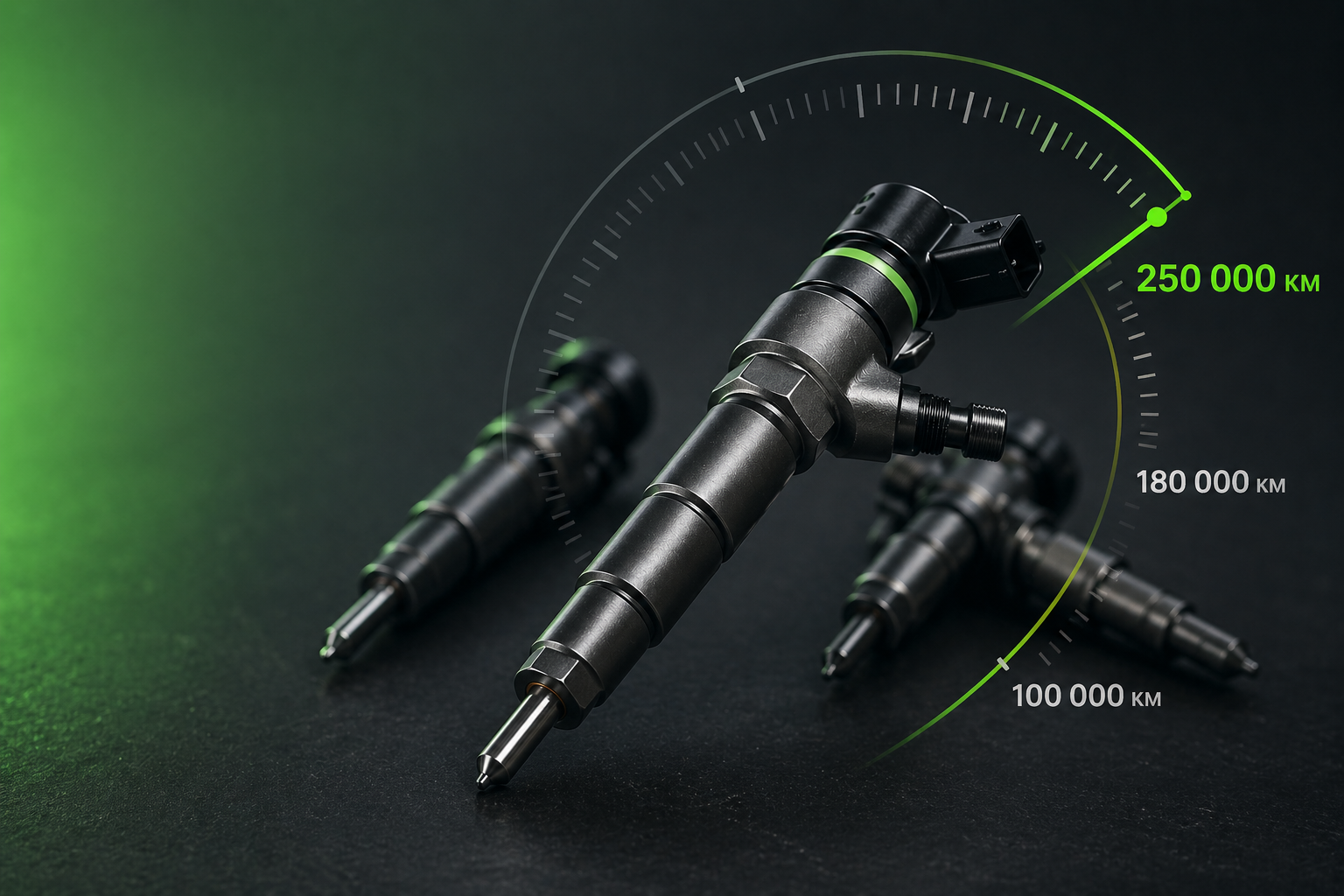
How long diesel injectors really last
Diesel injectors have no fixed service life the way oil or filters do. They are complex, high-precision parts that work under very high pressure, so how long they last always depends on how the vehicle is used.
On average, injectors can last anywhere from 150,000 to 300,000 kilometers. But that figure is only a rough guide. One vehicle can cover 300,000 km without any work on the injectors, while another starts showing the first symptoms at 120,000–150,000 km.
This is especially true of modern Common Rail systems (from Bosch or Delphi, for example), where injector precision is extremely high. Even a small deviation there immediately affects how the engine runs.
What service life actually depends on
Injector life is shaped far more by how the vehicle is used than by mileage.
First and foremost comes fuel quality. Diesel contaminated with impurities or water leaves deposits inside the injector, wears the nozzle and disrupts its operation. Even if you don't notice it right away, the wear process has already started.
The second key factor is the fuel filter. If it isn't changed on time, all the fine dirt and water go straight into the injectors. This is one of the most common reasons for premature repairs.
Driving style matters too. Constant short trips, cold starts and heavy loads all speed up wear. The engine simply never runs in its optimal range, and that takes a toll on the entire fuel system.
Don't forget the overall condition of the system either. If there are problems with the high-pressure fuel pump (HPFP) or fuel pressure, the injectors end up working under the wrong conditions and wear out faster.
How to tell your injectors are worn
Interestingly, injectors rarely fail "all at once". It is usually a gradual process, and the vehicle starts giving you warning signs.
At first, fuel consumption may creep up slightly. Then you get a slight loss of pulling power and the car accelerates less eagerly. The engine may run harsher, or small vibrations may appear.
Drivers often ignore this because the car still drives. But over time other symptoms join in: smoke from the exhaust, harder starting, an unstable idle.
This is exactly the point where it's best not to put off diagnostics any longer.
Should injectors be replaced "by mileage"?
No, and this is an important point.
Injectors aren't replaced just because the vehicle has covered a certain number of kilometers. They are checked based on their actual condition.
In many cases the problem can be solved much more simply: by cleaning, adjustment or a partial repair. Full replacement is only needed when the part can no longer be restored.
That's why diagnostics matter more than any "mileage guidelines".
How to genuinely extend injector life
There's nothing complicated here, but these things are often ignored.
Good-quality fuel is the foundation. You don't have to hunt for the perfect filling station, but you should avoid the obviously dubious ones.
Regular fuel filter replacement is another critical point. It's an inexpensive part that genuinely protects the whole system.
And periodic diagnostics. Even when everything seems to be working fine, a check helps catch a problem before it becomes serious.
When you should definitely have your injectors checked
There are a few situations where it's better not to postpone diagnostics.
- If the odometer has passed 150,000–200,000 km, that alone is a reason to at least have the system checked.
- If symptoms have appeared, such as higher consumption, smoke or loss of power, all the more so.
- And if the car simply "doesn't drive the way it used to", that's a warning sign as well.
Conclusion
Diesel injectors can last a long time, but their service life always depends on operating conditions. On average that's 150,000–300,000 kilometers, but the real lifespan is determined by condition, not by numbers.
The smartest approach is not to wait until the problem becomes obvious, but to have the fuel system checked in good time. That helps you avoid expensive repairs and keep the engine running properly.